
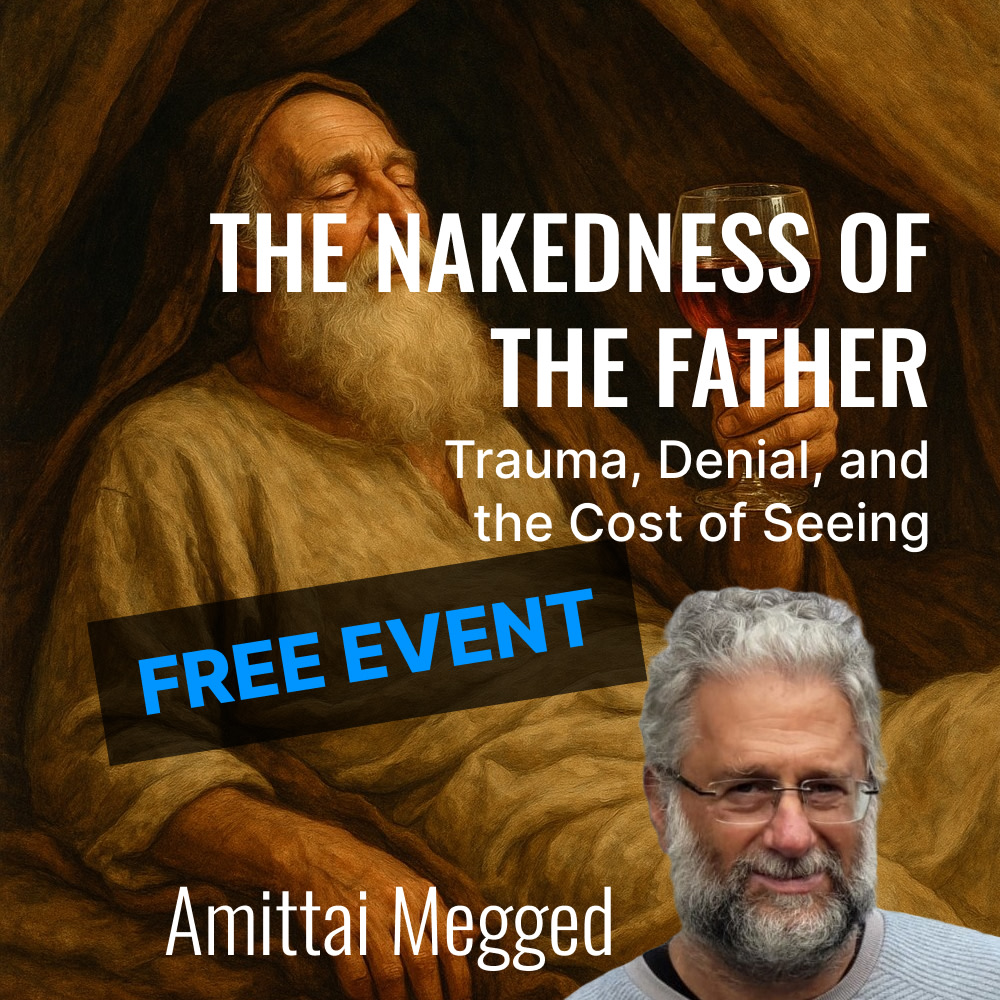
This talk examines how trauma—both personal and collective—is not only caused by acts of harm, but more profoundly sustained by systems that forbid us to recognize those harms.
In families, communities, and nations, trauma is preserved across generations through an unspoken commandment: do not see the moral failings of your parents, your teachers, your leaders. At the heart of this mechanism lies a foundational biblical story: Noah’s drunkenness and the curse placed on Canaan. Traditional interpretations have twisted this simple episode into elaborate justifications for Noah’s extreme reaction, suggesting Ham committed unspeakable sins. But the text itself reveals something far more subtle and dangerous: Ham saw what he wasn’t supposed to see—his father exposed in shame—and was punished not for wrongdoing, but for perceiving.
The story encodes a psychological and cultural injunction to blind ourselves to the nakedness— the imperfection, weakness, or hypocrisy—of those we depend on. This talk argues that the real curse is not on Canaan alone, but on all who internalize this taboo. It is a curse that damages the mind: to remain loyal, we must corrupt our perception, disable our moral clarity, and split ourselves internally. This mental disfigurement, I propose, is the deeper source of post-traumatic symptoms—not merely the original act of harm, but the inner violence of unseeing. Through this lens, we see how systems of loyalty—from families to religious and national narratives—demand a kind of psychological mutilation in order to function.
This lecture invites us to confront that ancient curse, and to reclaim our right to see clearly—even, and especially, when it means seeing our parents as human.
About the Guide

Amittai Megged
Amittai Megged (MFT) is the head of the training program for family and couple's therapy at the Tel Hai academic college in Israel. Social worker by training, and a certified family therapist and supervisor. Mr. Megged studied family therapy with Ivan Boszormenyi-Nagy, Harry Aponte, Dr. Susanna Bullrich, Dr. Daniel Gottlieb, Judith Grinbaum and Dr. David Schnarch. He is author of 6 books; the last three are "Differentiation Based Couple Therapy", "earning worthiness" and "Being a worthy couple". The founder and developer of Worthiness Based Psychotherapy.